What is a Hub Box?
Hub Boxes are the white metal boxes on stop-sign posts around the city. The City owns and maintains them, and red lettering on each one shows its location. Inside are a tethered walkie-talkie radio (Midland GXT1000 or equivalent) and up to 10 clipboards, each covering 8–12 assigned homes for damage and injury assessment. No key is needed: a coin or flat screwdriver opens it.
About 75 boxes are placed around the city (2021).
Structure
- 13 Areas under the March 2026 city plan (earlier documents said 14), each with a volunteer Area Coordinator / AECO
- Zones (4–9 per Area), each with a Zone Leader and a Hub Box
- Blocks of 8–12 homes (any shape), each with a “Good Neighbor” (formerly Block Captain)
When disaster strikes
- Check your household first, then walk to your nearest Hub Box.
- The first person there acts as Zone Leader until the assigned leader arrives, and reads the blue clipboard instructions.
- Volunteers take red clipboards and assess their assigned homes for damage and injuries.
- Completed forms go back to the Zone Leader, who radios the Area Coordinator.
- The Area Coordinator relays to the Ivins City Command Center / EOC, and responders are dispatched.
Before a disaster: Neighborhood Coordinators
Volunteer Neighborhood Coordinators take responsibility for 8–12 homes, including their own. They introduce neighbors to the “Our Emergency Preparedness Plan” form and Hub Box procedures, and share preparedness tips. Residents who aren't interested are politely left alone.
🗺️ Neighborhood map: find your Area, Zone and Hub Box
The City publishes an interactive Neighborhood Map, hosted on the Santa Clara GIS portal. Use it to find your Area, your Zone and the nearest Hub Box.
Open the Ivins Neighborhood Map
Source: Ivins City Emergency Preparedness pageWhat the City provides
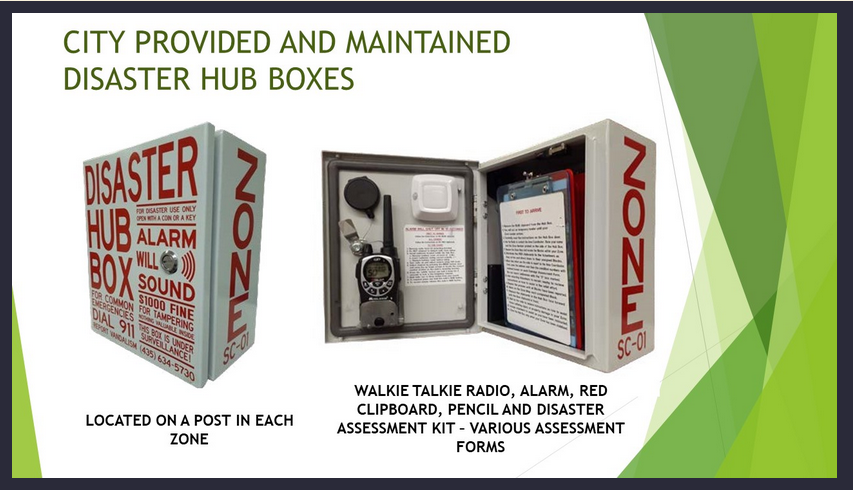
Image: Ivins City (“City Provided and Maintained Disaster Hub Boxes”)
- Disaster HUB Boxes, provided and maintained by the City and mounted on a post in each Zone. Each holds a walkie-talkie radio, an alarm, a red clipboard, a pencil, and a Rapid Disaster Assessment Kit.
- Rapid Disaster Assessment Kit (RDAK): a Block map, an instruction sheet, and assessment forms.
- CERT: a full 9-week course, available online, with periodic hands-on training at little or no cost.
- Preparedness Seminars: free, taught by local experts on a range of emergency topics.
Roles in the Hub Box system
Area Coordinator
Before: serves on the City's Emergency Preparedness Committee. Recruits and trains Zone Leaders on the radios, the RDAK forms and the HUB Box, and coaches them in training Good Neighbors. Runs communications exercises and keeps Hub Boxes stocked (battery checks, replacement forms).
During: receives assessment reports from Zone Leaders by walkie-talkie and relays them to the Emergency Operations Center / Command Center over public-safety (police-style) radio.
Zone Leader
Before: with the Area Coordinator, organizes the Zone into Blocks of 8–12 homes. Recruits and trains Good Neighbors (Neighborhood Coordinators), helps set or adjust neighborhood boundaries, keeps the HUB Box and RDAKs up to date, and runs radio drills.
During: supervises HUB Box operations, reviews returned assessment forms, radios results to the Area Coordinator, and keeps Good Neighbors updated and encouraged.
Good Neighbor / Neighborhood Coordinator
Formerly called Block Captain. A resident of the Block who serves as its representative.
Before: visits neighbors at home and builds rapport. Explains the “Our Emergency Preparedness Plan” (OEPP) form, invites neighbors to seminars, and surveys their useful skills and resources plus any special needs (oxygen, electricity, medical). Passes special needs to the Zone Leader and keeps records. Neighbors who aren't interested are politely left alone.
During: assesses each home with the red-clipboard forms, reports to the Zone Leader, and helps with other Blocks as needed.
The OEPP form (“Our Emergency Preparedness Plan”)
Each household gets two identical copies, labeled A and B. Copy A is yours: fill in everything and keep it for emergencies. On copy B, record only what you want First Responders to know about the people in your home (medical needs, oxygen, electricity, mobility, and so on), then give it to your Neighborhood Coordinator. The form uses a House ID in the format House # – Neighborhood # – Zone # – Area alpha code. It also includes an Emergency Resource & Skills List where you can volunteer skills (CERT, CPR, EMT, medical, electrical, plumbing, HVAC, carpentry, welding, languages, military and more) and resources (HAM radio, walkie-talkies, satellite phone, generator, 4WD pickup, trailers, chain saw, tents, water filters and more). Download the OEPP form (PDF)
Sources: Ivins Disaster Preparedness Plan – Community; Ivins City Disaster Response Plan; City Council minutes 2021-10-07. The Hub Box concept was developed by Mayor Chris Hart and refined by the Ivins Emergency Preparedness Committee.
Volunteer as a Neighborhood Coordinator